
Origin of Silk: History, Etymology, and the Value of the Fiber for Cosetex

Origin of Silk: History, Etymology, and the Value of the Fiber for Cosetex
Etymology and meaning of the Word “Silk”
Understanding the meaning and origin of silk word means entering the fascinating world of silk through the main door, allowing for a deeper comprehension of its tactile, functional, mechanical, and physical characteristics.
To understand the etymology of silk is to grasp the profound connection between language, material, history, and culture—a connection that Cosetex has preserved and enhanced for over a century.
Latin and linguistic origin of Silk: from “sēta” to “sericum”
The Old English word “sioloc” is probably the origin of silk ant it was referred to Latin sericum that is a term derives directly from Latin: sēta (or saeta).
Originally, silk referred to a stiff bristle, generally a coarse and cohesive hair.
From this ancient root begins a linguistic and cultural journey leading to the true origin of silk as we know it today.
From Bristle to Shining Thread: the evolution of silk in History
In Late Latin, and later within the Romance languages, silk came to describe a fine and shiny filament more closely connected to the shimmering, delicate silk thread that was beginning to be known in the Western world, produced from the cocoon of a small domesticated moth.
In Old Italian, seta became the specific term for the filament produced by the silkworm, as well as for the discontinuous fiber, the silk waste derived from it.
This linguistic evolution marks a crucial stage in the history of Italian silk and in the growing cultural and productive importance that silk would assume in Italian society.
The Meaning of the Adjective Silky “Setoso”
Silkly “Setoso” is an adjective that immediately accompanied the noun silk and adopted all the shifts in meaning that silk acquired over time.
From Rough to Soft: The Semantic Transformation of “Silk”
Originally, silkly described objects covered with bristles, rigid filaments, implying something coarse or rough to the touch.
Over time, as silk changed meaning, silkly came to refer to materials that, on the contrary, were soft and smooth to the touch.
This change reflects the sensory transformation of the origin of silk and its current symbolic value in modern language.
The People of the Seres, Silk, and the Greek Connection
A deeper look into the term “serico” (silken), as related to silk fabric, takes us to the society through which silk reached the Western world: the East, and in particular, ancient China, the true origin of silk.
The Greek and Latin Connectioni in the silk Etymology
The millennia-old secret of ancient silk production, guarded by Chinese civilization for centuries, referred primarily to silk fabric itself:
- from Latin sericum,
- from Greek σηρικός (sērikós), meaning “of the Seres” (pertaining to the Chinese people known as the Seres).
Summary of the Origin and History of Silk
- SILK originally meant bristle, then, by extension, thread, and ultimately silk thread.
- SERICUM referred to the actual silk fabric, the precious good carefully guarded by Eastern culture, the product that literally “came from the people of the Seres.”
This represents the key transition between the history of silk, the classical world, Eastern civilization and its Chinese origin, and the Western world.
From Serico to Modern Italian: Evolution of silk terminology
The origin of silk evolved geographically and linguistically:
- Ancient Greek: σηρικός (sērikós) = “of the Seres, Chinese”
- Latin: sericum = “silk”; sēricus = “of silk”
- Neo-classical and Italian: serico = “relating to silk” in a more refined and technical sense
The People of the Seres and the Ancient Silk culture
The term Seres seems to derive from ancient Chinese 絲 (sī), meaning silk.
It is therefore reasonable to believe that the Seres were so named because they were considered the foremost producers and custodians of true silk.
The people that represent a fundamental point in the historical and cultural origin of silk, a cornerstone of a millennia-old tradition still being studied and understood today.
Who Were the Seres?
The first historical references to the Seres appear in the 1st century BCE, in the writings of authors such as Strabo, Pliny the Elder, and Ptolemy.
The Seres were described as inhabitants of a distant, undefined region “at the very edge of the known world”,a land of plains and mountains “beyond the Parthians and the Indians.”
It is believed this referred to a region east of Persia and India, clearly associated even then with silk production.
Today, the term Seres identifies the ancient Chinese peoples of northwestern China, in the modern province of Gansu, in the Tarim Basin, a symbolic location in the history and origin of silk.
The Origin of Silk: A Secret Guarded for Centuries
For centuries, silk was entirely unknown outside China,a treasure and a closely kept secret.
Even today, it is difficult to determine the exact moment of silk’s discovery. Archaeological finds have pushed the use of silk by humans further back in time.
Only in the 2nd century BCE did silk begin to leave the Chinese Empire, when the envoy Zhang Qian opened the way to Central Asia,giving birth to the legendary Silk Road and spreading the origin of silk throughout the Western world.
Legends, Miths and the First Roman Accounts of silk
As soon as silk was revealed to the “other world,” its impact was so powerful that legends arose about its production.
The Roman historian Ammianus Marcellinus (4th century CE) wrote his own interpretation:
“Silk fabrics are made from the soil! The Chinese earth is soft like wool. After irrigation and special cultivation, it can be used to form silk threads!”
Ammianus was also the first to mention the people of the Seres, describing a beautiful Persian city named Batna, where, during a great fair, the Seres displayed their products—including a wondrous shining fiber.
These accounts are the earliest documented traces of the origin and history of silk in the Roman world.
The Origin of Silk for Cosetex: Tradition, Knowledge, and Made in Italy innovation
Knowing the meaning of words and their origin creates a special bond, it helps define their essence and builds a deeper relationship with the material itself.
Enhancing the Knowledge of Silk and Its Origin
Understanding the silk and its meaning as word, carries the same value as the experience gained in over 120 years of Cosetex history, an experience that has led to mastering silk’s technical excellence, its properties, and its role as a fiber and material of the future.
Silk as a Material of the Future and a Symbol of Made in Italy excellence
For Cosetex, a 360-degree knowledge of silk is essential to propose ideas, solutions, innovations, and products within the most modern tradition of Made in Italy.
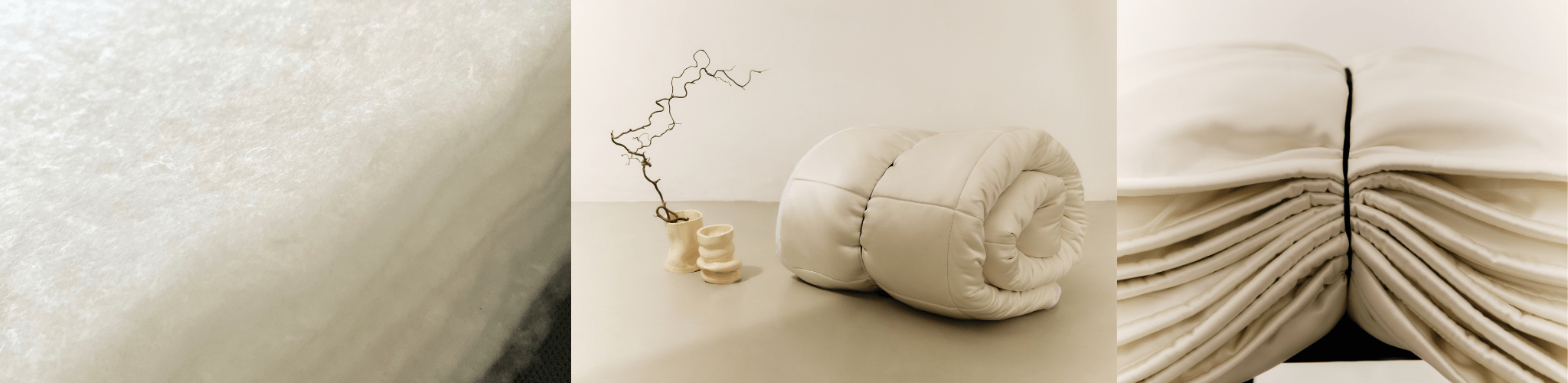
The T.Silk project for silk padding insulation and the T.SILK COLLECTION for silk bedding were born from the historical study of silk, combined with research into its outstanding qualities.
For Cosetex, preserving and reinterpreting the silk means enhancing a heritage of culture, technique, and beauty, projecting it toward the future evolution of silk fiber in the contemporary world.
Cosetex: The Origin of Silk and a Vision for the Future
Discover more about silk and the value of natural silk fiber by exploring the history, origin and innovation of silk, through Cosetex’s products and projects.
The story of silk continues, interweaving ancient knowledge, innovation, and the distinctly Italian passion for excellence.