
Silk Filtration for Water Purification: Eco-Friendly Removal of Dyes and Oils
Silk filtration for Water Purification: An Eco-Friendly and Sustainable Solution
Among its countless properties and benefits, recent studies and research have established how silk can be effectively used for filtration and the purification of polluted natural waters and for sustainable water purification during remediation and cleanup operations following accidental or intentional spills of oils, dyes, and pollutants.
Silk filtration for water purification is a valuable aid in maintaining and protecting the environment and the land, thanks to a fiber that naturally contributes highly positively to environmental protection.
Silk filtration for Water Purification: A Natural Material That Removes Oils and Dyes
Silk is known as a prized fiber for exclusive clothing and fashion apparel. Silk boasts a series of excellent chemical and physical properties, and in every area of application, it demonstrates specific characteristics that make it a truly innovative material, the material of the future, including as an eco-friendly silk water purification material.
How to purify natural water with eco-friendly materials: the role of silk
Using a waste product to remove highly polluting elements from water. This is the brilliant result of a team from the Cornell Center for Materials Research, the Cornell NanoScale Science and Technology Facility, a member of the National Nanotechnology Coordinated Infrastructure, supported by the National Science Foundation.
The aim of the study, led by Larissa Shepherd, assistant professor in the Department of Human-Centered Design in the College of Human Ecology, was to identify products and materials capable of cleaning up water spills efficiently, effectively, and reusably. The team highlighted how discarded silk yarns and silk waste fabrics are ideal materials for biodegradable silk filetrs that can remove dyes and oil from water, acting as true natural water filters.
Silk for Nanofiltration Membranes
Nanofiltration membranes are essential for the treatment of industrial wastewater or water filtration systems, including domestic ones. These membranes are capable of removing a wide range of pollutants from water (contaminants, heavy metals, microorganisms).
Current membranes, in addition to being made of synthetic materials and therefore highly polluting, require very high operating pressures, up to 10 bar, equal to 10 times atmospheric pressure, resulting in high energy consumption and cumbersome installations.
A study by the Department of Civil Engineering, Faculty of Engineering at the University of Hong Kong (HKU) tested an innovative silk membrane for wastewater treatment that:
- it is 10 times faster and more efficient than traditional membranes
- Removes 99% of pollutants
- Operates in a minimum vacuum system without intense pressure
- Reduces energy consumption by 80%
Natural water pollution: causes and problems
Every year, thousands of tons of pollutants are deliberately or unintentionally released into surface waterways. Dyeing and finishing materials, often derived from the textile industry, create high levels of pollution, resulting in barren agricultural land and a shortage of drinking water. It is estimated that over 100 million gallons of oil end up in the oceans each year, with serious consequences related to water pollution from industrial wastewater without any natural filter for polluted water.
Natural Water Purification: Ecological and Sustainable Solutions
Water purification techniques have seen considerable progress and innovation in recent years. The study and use of advanced materials capable of absorbing oil, dyes, and petroleum derivatives has increasingly become a critical area of research.
Traditional methods (combustion, chemical dispersants, chemical solidification, biological solidification) have highlighted a series of significant critical issues, and unfortunately, the effective materials discovered are primarily synthetic.
Unlike, natural purification techniques such as silk, synthetic materials demonstrate the serious incongruity of being materials designed to solve a pollution problem. These materials, being non-biodegradable, pose significant pollution problems during their production, use, and end-of-life, resulting in enormous disposal problems.
Silk for Natural Water Purification: Properties, Excellence, and Advantages
Silk filament is a natural fiber produced by silkworms, with a fibrous structure composed of two natural proteins, sericin and fibroin.
Sericin and fibroin, thanks to a specific molecular structure of overlapping sheets (B-sheets), give silk its hydrophobic properties and high absorption capacity.
This results in a high capacity to capture and absorb oil particles, dyes, and substances dissolved in water, making it one of the best natural filtration materials.
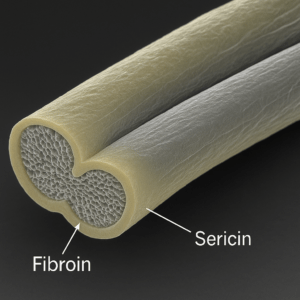
Biodegradable silk sericin and fibroin
Silk fibers from silk waste have the unique property of having surface contact angles greater than 140°, enhancing their hydrophobic and absorbent properties. Above all, they retain chemicals without degrading and can be easily cleaned and reused, making them effective biodegradable water filters.
Natural water purification with silk: the case of methylene blue
Methylene blue (MB) is a cathode dye chosen for this study because it is commonly used in laboratories and industry. It has potential mutagenic risks and is carcinogenic, bioaccumulating even at low concentrations:
- 12 mg of silk filament yarn, in the first 10 minutes and at concentrations up to 100 ppm, has a methylene blue (MB) removal efficiency of 90%.
- It has an adsorption capacity of 145 mg/g at concentrations of 800 ppm, highlighting the effectiveness of the natural removal of dyes from water.
Silk for the purification of oils and hydrocarbons in natural waters
To simulate the problems arising from oils spilled into water, common oils (gasoline and corn oil) were used, measuring the oil absorption per unit weight.
Silk fabrics can absorb twice their weight. Thanks to their specific contact angles, silk waste fabrics absorb quantities greater than twice their weight, offering eco-friendly oil absorption and purification against spilled oils.
Silk and environmental sustainability: the new frontier of natural water purification.
Silk fabrics and yarns are highly efficient and reusable bioabsorbents for capturing and removing oils and dyes, with superior performance and overall sustainability compared to synthetic products.
They maintain a high level of capacity (greater than 50% for at least 10 cycles) even after subsequent uses, once cleaned and reused. Fabrics and yarns derived from silk by-products and silk waste and, as such, reused, are highly efficient, in some cases even more so, combining complete sustainability and recyclability.
Silk: A Natural Barrier to All Forms of Pollution
Silk has proven, once again, to be a highly innovative material capable of ensuring high levels of environmental protection:
- The silk production system allows for a reduction in CO2 and greenhouse gases and an increase in oxygen for every kilogram produced.
- Silk is free of plastic microfibers that are harmful to humans and the environment.
- Silk is composed of two proteins that derive from and return to nature without any form of pollution.
The Cornell Center study highlights how silk’s excellent characteristics enable this fiber to be used for sustainable and innovative purposes: actively protecting the environment, purifying water contaminated by oils and dyes, and as a green innovation for water purification.