Cruelty Free Silk, no-violent silk

Cruelty free silk, Non-violent silk
What is the relationship between silk production, respect for animal conditions and the concept of cruelty free and non-violent silk?
To answer this question, it is necessary to define the meaning of the term cruelty free, what the silk production process and the different types of silk in existence really is, focusing on the aspects related to the animal involved in the production of the silk cocoon.
To answer this question, it is necessary to break away from some preconceptions, analyzing, also in terms of knowledge, a series of information and facts that are often little known.
What does cruelty free mean
The English baroness Lady Dowding, head of the NAV (“National Anti-Vivisection Society”), coined the term cruelty free for the first time in the late 1950s in London, to indicate cosmetic products that were not tested on animals. In 1959, through the charity “Beauty without cruelty” she allowed the cruelty free culture to spread.
In the 1970s, in the United States, Marcia Pearson with the group “Fashion with Compassion” developed the cruelty free culture.
The cruelty free concept was born with the birth of the animal rights and protection movements. The initial reference was to specific production fields (research, cosmetics, medicine, pharmaceuticals), within which animal testing was foreseen, causing suffering and in some cases violent death.
In its modern evolution, the term cruelty free indicates those products that, in addition to not involving testing on live animals, are careful not to cause suffering and exploitation.
There is currently no comprehensive legislative discipline that defines cruelty-free, but rather a series of interventions, even at EU level, aimed at regulating, or rather avoiding, animal testing in some specific fields: Regulation (EC) 1223/2009 imposes, for example in the cosmetics field, a ban on testing on animals for the finished product, a ban on testing for individual ingredients, a ban on importing products on which experiments have been performed.
What the Silk is
The term silk refers to a natural fiber with some peculiar chemical-physical characteristics:
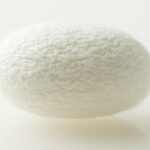
The Silk – Chemistry and Proteins
The Silk – Carachteristics
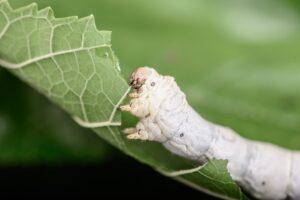
Silk, or it would be better to say the Silks, is a natural fiber of animal origin that is naturally produced by some breeds of lepidoptera that differ from each other in genetic qualities. Through the secretion of a combination of proteins, the silkworms, once mature, wraps itself inside a cocoon to implement its transformation from larva to butterfly.
Chemically, silk is a combination of natural proteins whose production involves the agricultural sector of the cultivation of the mulberry tree, the zootechnical sector of the breeding of the silkworm for the production of the silk cocoon and the artisanal and industrial sector for the obtaining of the silk thread or fiber.
Silk is a fiber with a thousand-year history that was created by nature to respond to a need for survival and maintenance of an animal species, and has seen the intervention of man who has used and perfected it to obtain a textile fiber.
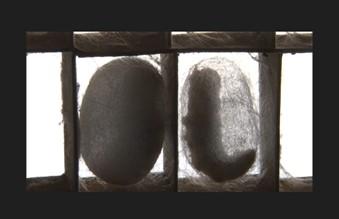
Continuous and Discontinuous Silk
Silk is the only natural fiber from which it is possible to produce a Thread (continuous filament) and a yarn (discontinuous fiber). It is therefore divided into two large families:
- Silk for the production of continuous thread
- Silk for the production of yarn and discontinuous fiber
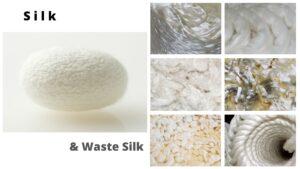
The production of continuous silk thread is made through an operation, the “reeling”, which starting from the intact cocoon, searches for the initial end of the thread and partially unwinds the cocoon.
The starting point for the production of continuous thread presupposes the presence of an intact cocoon. In order for the cocoon to be intact (not pierced by the larva that after transforming into a butterfly, would exit through a hole created in the upper part of the cocoon), it is necessary to kill the silkworm inside the cocoon, through a drying process.
The production of discontinuous silk comes from a series of successive processes on raw materials that can in turn represent by-products of silk supply chain processes. The very fact of being discontinuous does not derive from the continuous thread and therefore from the intact cocoon and therefore from the killed lepidopteran.
Silk and cruelty free – An incorrect simplification
Silk and cruelty free silk or non-violent silk is a topic that is often simply dismissed in equalities:
SILK = continuous thread = killing of the silkworms
The second equality is certainly always true, (continuous thread = killing of the silkworm), because:
- Once the larva has transformed into a butterfly, to exit the cocoon it proceeds through the secretion of an acid to damage the upper part of the cocoon.
- In a short time a hole is created that allows the butterfly to exit.
- The presence of this hole creates in several parts the break in the continuous unwinding of the thread. Therefore it is not possible to obtain continuous silk filaments from these cocoons
The only way to obtain continuous thread is to have an intact cocoon and therefore the animal is prevented, through drying and its death, from transforming into a butterfly
The first equality is NOT always true, (SILK = continuous thread), as there is a vast production of products and yarns in discontinuous silk fiber that does not necessarily derive from continuous thread and therefore from an intact cocoon. Therefore it is valid the follow disequality:
Discontinuous Silk ≠ killing the silkworms
The breeding of silkworms for the production of silk
The breeding and growth of the silkworm to obtain the silk cocoon is characterized by a series of peculiarities and facts that need to be considered in the evaluation of the concept of cruelty free:
- The type of lepidopteran most used for the production of silk, (the Bombyx Mori), is domesticated and selected over thousands of years of silkworm breeding, incapable of living without the help of man, destined to die and become extinct if not bred.
- The set of natural genetic crosses carried out by man have created breeds with a lower mortality rate, more capable of fighting diseases and resistant to climatic changes that often cause premature death
- There is a vast biography that testifies how the larva and the butterfly that derives from it, are devoid of a cognitive and neurological system and as such incapable of perceiving situations of danger to their life, suffering and pain
- The evolution of the life of the lepidopteran subject to continuous physical mutations, the last of which from larva to butterfly would not be compatible with the presence of an apparatus capable of perceiving pain and suffer
- Once the transformation has occurred, the butterfly has a very high mortality rate in the first seconds of life. Due to its intense white color, easily identifiable, it is immediately prey to a considerable number of predators, usually birds.
- The butterfly is not autonomous in the reproductive phase. Human intervention is also essential in this phase, placing male and female butterflies in the same space
- The butterfly lives only a few hours during which it mates and produces eggs, it has no visual apparatus, it does not have a digestive system and mouth structures that allow it to feed
Since it is a small worm/earthworm, it is possible to compare its death, before transforming into a butterfly, to the quantity of worms and earthworms killed during, for example, a simple agricultural operation of ploughing a field of land or during operations of natural disinfestation of agricultural crops (in tomato cultivation, enormous quantities of worms and lepidoptera are killed by antagonistic insects that devour the animals alive)
Other aspects:
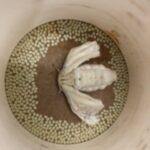
- in many production countries, frozen or dehydrated larvae represent a form of food for populations, especially in rural areas
- there are legislative projects, also at the European Community level, that will make various types of insects usable for food purposes, including chrysalises and silk cocoon larvae
- the chrysalises of dried larvae are a valid fertilizer capable of completely replacing a wide range of polluting chemical fertilizers
- the chrysalises of dried larvae are used for feed in fish farming instead of GMO foods or chemical feed
Cruelty free, non-violent (discontinuous) silk
If within the world of continuous silk it is impossible to have a production that does not involve killing the larva, in the world of discontinuous silk the best raw materials can derive directly or indirectly from cocoons not requiring the continuity of the fiber can provide for the non-killing of the larva.
Mulberry cruelty free discontinuous silk
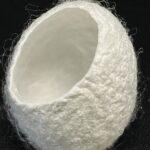
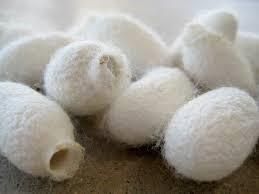
The so-called butterfly cocoons, (a term that indicates when the butterfly emerges from the cocoon, creating a hole in its upper part), can be used for the sole production of discontinuous silk fiber having the non-secondary characteristic of having a significant quantity of silk fiber present.
The cocoons resulting from the reproductive activity (to create eggs for future productions) that are cut intact, usually lengthwise, in order to preserve and help the animal to transform into a butterfly are used for the production of numerous variants of discontinuous fiber products.
Cosetex creates collaborations and projects aimed at collecting these types of cocoons that are sent to all those processes that will give rise to the production of:
- cruelty free silk fiber,
- cruelty free silk sliver,
- cruelty free silk yarns
- cruelty free silk fabrics
- cruelty free silk padding
Wild cruelty free silks
In nature there are a series of types of cruelty free silkworms (by nature) that due to their particular genetic characteristics do not require the completion and closing of the cocoon but that usually maintain a small hole in their upper part in order to facilitate the exit of the larva once it has transformed into butterflies.
These are mostly so-called wild silks that self-reproduce in the wild and that have qualitative and feeding characteristics of the silkworm different from the Bombyx Mori.
The ERI Silk or “Silk of Peace”
The most relevant case of cruelty free silk or non-violent silk is that of Aimsha silk or silk of peace. It has had visibility in the past for having been brought as an example by Mahatma Gandhi in his philosophy of non-violent struggle. It is called “ERI” Silk and derives from the lepidopteran Philosamia Ricini whose silkworm feeds on castor leaves. In nature, the silkworm does not complete the cocoon leaving an opening in the upper part of the cocoon interrupting the process of production of the continuous filament that. The creation of this slit through which the larva passes once it has transformed into a butterfly presupposes that:
- it is not necessary to kill the larva before it transforms into a butterfly as the cocoon is already pierced and as such already unusable for continuous thread
- the cocoon can only be used exclusively for discontinuous fibre products
Silk – a sustainable fibre and an ethically valid system
An important and not secondary collateral argument in determining the ethics of the silk system presupposes a 360-degree evaluation of it, including how the cultivation of the Mulberry tree, silkworm breeding, the production of various types of silk products are capable of guaranteeing a high level of ethics, a series of pluses consistent with complete sustainability as defined in Agenda 2030:
- economic sustainability
- environmental sustainability
- social sustainability
Insight
Organic Silk and protection of the territory
Silk, Mulberry and environmental protection

Silk -CO2 + O2
Value of Silk recycling
Sericulture and ethical projects

Silk free from plastic microfibres
Silk to support rural economy