
Silk: a natural biodegradable textile fiber

Silk: natural biodegradable textile fiber
Silk is a biodegradable natural textile fiber, one of the oldest textile fibers that is characterized by its excellence and its ecological, mechanical, comfort and sustainability properties.
The global textile industry is one of the most polluting and environmentally problematic sectors.
The search for truly sustainable and ecological fibers has become a priority for consumers. Among the many fibers, the natural textile fiber par excellence is silk, which is an example of how nature creates simple solutions capable of solving the planet’s problems.
Silk a natural textile fiber
Silk is often associated to biodegradabble fabrics and ecological fabrics with elegance, luxury and exclusivity but boasts technical, mechanical, chemical and ecological properties of primary importance
What is a textile fiber
The subdivision of fibers in the textile panorama, although the latter is decidedly complex, is quite simple and immediately understandable based on the key distinction between natural fibers Vs chemical fibers, dividing the latter into artificial fibers and synthetic fibers

There are more and more attempts to make this scheme more complicated, for example by inserting new pseudo-categories with the primary purpose of confusing the final consumer.
Silk is a natural textile fiber of animal origin derived from the activity of a lepidopteran that in the form of a silkworm produces a filament to create a cocoon in order to implement a transformation from caterpillar to butterfly.
Silk a natural textile fiber that protects the environment
Silk comes from nature and returns to nature in a completely circular cycle, minimizing (if not eliminating) any production waste that easily becomes secondary raw material for other uses.
In recent years, terms such as sustainability, compostability and biodegradability have taken on increasing significance.
The natural textile fiber of silk is a fiber and a totally sustainable production system, and it is interesting to analyze it from the point of view of its biodegradability and its relationship with compostable materials
Biodegradability and Compostability: what do they mean?
The terms compostable and biodegradable are often used as synonyms and often with meanings that do not correspond to reality.
Compostable and biodegradable highlight characteristics and properties of a fiber, a substance or a material that are actually very different from each other
What does biodegradable mean
A material is biodegradable if it can decompose in nature into simpler elements and/or substances thanks to the enzymatic action of microorganisms and bacteria, atmospheric agents or sunlight.
The biodegradation process must be a completely natural process in which the original organic substances are transformed into inorganic molecules (mainly within the carbon cycle), to be reintroduced into the natural cycle as a primary element of the animal and plant life cycle. All of this presupposes the non-release of harmful and polluting substances
The European Environment Agency (EEA) defines biodegradability as: “the extent to which a substance can be decomposed by bacteria and fungi leaving residues of degradation that are not toxic”
However, Biodegradable is not synonymous with harmless or ecologically positive material. During biodegradation phenomena, harmful elements can be developed that can damage the environment and degrade over longer periods than the material from which they derive.
Biodegradation can be partial and incomplete and, even if it complies with the criteria specified by the various regulations, it could allow the accumulation of highly harmful parts with a very serious environmental impact
What does Compostable mean
The European standard EN13432 of 2002, with reference to the requirements for packaging recoverable through composting and biodegradation, has tried to fill the gaps of Directive 94/62/CE by defining the characteristics that a material must have in order to be considered compostable.
A material is compostable if:
- From a metabolic point of view it converts into carbon dioxide by at least 90% within the first 6 months in an environment rich in carbon dioxide, according to the EN14046 standards
- If in contact with organic materials for a period of 3 months its mass is made up of parts smaller than 2 mm by 90% (EN14045), (Disintegrability)
- It has no negative effects on the composting process
- It satisfies a low concentration of heavy metals
- It respects the pH values
- It respects the salinity values
- It respects the values of volatile solids
- It respects the concentration levels of nitrogen, phosphorus, magnesium and potassium
Each of these points must be verified to define a compostable material; therefore, any material that is biodegradable but does not comply with the other parameters (for example, produces high concentrations of volatile substances or has a high PH), is not compostable. A material that disintegrates into very small, non-degradable pieces is also not considered compostable
Silk: a biodegradable natural textile fiber
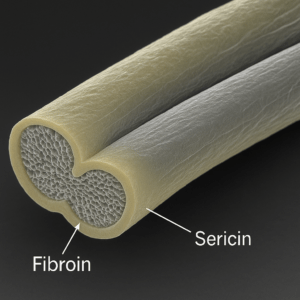
Silk is a natural textile fiber formed by a series of microfilaments. The single silk filament that is obtained from the silk cocoon is composed of:
- Fibroin 70/80%: natural fibrous protein
- Sericin 20/28%: natural protein
- 2.5/3.0% waxy and organic fatty substances
From a chemical point of view:
- Carbon 45.00%
- Hydrogen 5.00%
- Nitrogen 20%
- Oxygen 30%
Silk: a compostable natural textile fiber
The protein composition of silk determines that it is considered compostable in ideal conditions.
If we insert the natural silk fiber into a composting system, it will decompose effectively and will also help to release elements such as nitrogen and essential nutrients that are particularly important for the quality of the process and the soil.
Decomposition times are different depending on the state in which the natural silk fiber is found (fiber, waste, yarn, fabric).
Nature created the silk filament to protect the vital activity of the silkworm from external atmospheric agents and at the same time to be difficult to attack, in a short time, by bacteria, fungi and microorganisms in general:
- maximum protection of the silk cocoon
- silk is naturally antibacterial and antifungal.
Its propensity to not accumulate humid micro-pockets in some cases can slow down but not modify its compostability.
Natural silk without chemical treatments or coating can be composted in domestic and industrial plants.
Silk: a natural biodegradable textile fibre
Natural silk fibre is a biodegradable material: once silk is left in the environment, its elements, thanks to the action of proteolytic enzymes (capable of breaking down protein bonds), will return to nature in the form of humus, feeding the soil and subsoil.
The biodegradability times are determined by different factors, including the form that the fibre takes:
- Short, medium time for natural free fibres (fibres, waste, yarns)
- Medium-long time for fabrics
Any treatments even if for organic fabrics (colouring, chemical and finishing) can affect these times.
Real biodegradability test of silk fiber
An empirical test scheduled at our factories has allowed us to highlight in a real and documented way the aspects and times of complete and natural biodegradability of silk fiber:
- 2 samples of silk fiber were placed in an external lawn area in front of our offices, in the spring / summer period in direct contact with atmospheric phenomena, simulating abandonment in the environment
- A sample was placed on some unsealed ceramic tiles and a sample in direct contact with the ground
- After 15 days from positioning the fibers from a dispersed form assumed a single mass consistency and some primary forms of plants began to emerge with the presence of insects and small worms
- After 45 days plants and vegetables had extensively colonized the fibers in a mass in close contact with the ground, for the fibers placed on the ceramic tiles the process was of the same type even if partially slowed down
- After 60 days the fiber was completely incorporated into the ground and vegetation

Ecological impact of silk
Silk has a reduced ecological footprint thanks to a series of excellent characteristics of compatibility and environmental protection:
- cultivation of the mulberry tree that absorbs CO2 and increases Oxygen with silk products that allow compensation of greenhouse gases and reductions of considerable social costs
- The Mulberry tree is protective of the environment and facilitates agroecology and/or regenerative agriculture
- There is no waste and the production system is highly circular by reusing every scrap or by-product
The impact of the use of fertilizers is very low, the same chrysalises are a valid natural fertilizer - There is no release of chemical substances and elements
- Silk is free from any type of plastic microfibers
- Its intrinsic durability allows to create products that last longer, positioning itself as a real alternative to Fast Fashion
Silk is a natural, biodegradable, compostable and sustainable textile fiber, capable of combining excellent technical qualities and comfort with a reduced environmental impact. A perfect model of natural circular economy